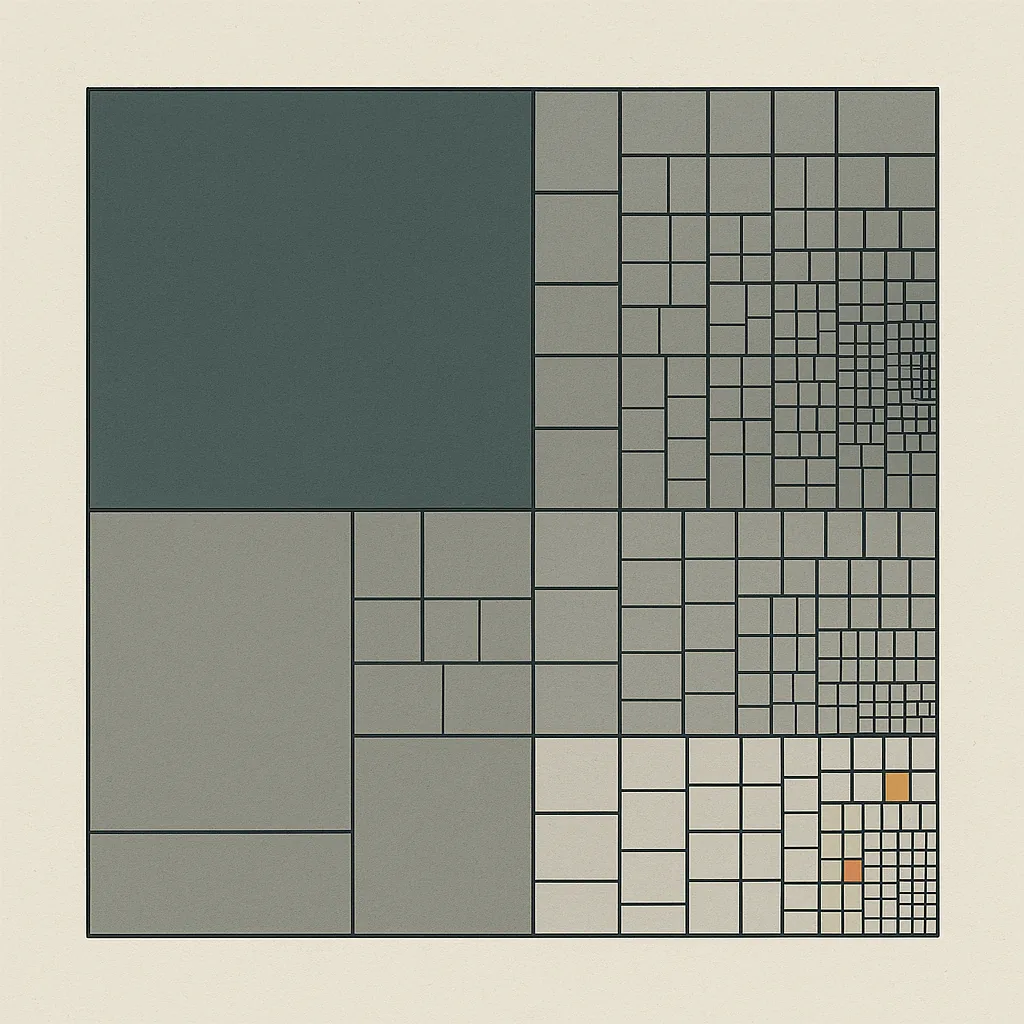
Ask a CI team what they cover and a common answer is a list of tumour types. Lung, breast, colorectal, prostate, haematology. It sounds like coverage. It is closer to a table of contents.
The problem is that a tumour type is not a market. Non-small cell lung cancer is dozens of markets: first line versus second line and beyond, EGFR-mutant versus ALK-rearranged versus KRAS G12C versus wild type, PD-L1 high versus low, squamous versus non-squamous, monotherapy versus doublet versus chemo-immunotherapy combination. An asset winning in one of those cells may be irrelevant in the one next to it.
So a landscape that lists forty NSCLC assets tells you almost nothing about whether any of them competes with yours. That is not a presentation problem. It is a data model problem, and it determines whether the function can answer questions at all.
The four dimensions that actually matter
- Tumour type — necessary, nowhere near sufficient
- Line of therapy — 1L, 2L+, maintenance, adjuvant, neoadjuvant, perioperative
- Biomarker or molecular subset — the population the label will actually name
- Monotherapy or combination — and if combination, with what, because the partner may be a competitor's asset
What breaks when you track at tumour level
You cannot answer the only question that matters. "Does this compete with us?" requires knowing whether the competitor's trial enrols the population your label covers, in the line you are positioned in. Tumour-level tracking cannot resolve that, so every question escalates into bespoke analysis.
Standard of care shifts invisibly. When a new agent moves into first line, the entire second-line landscape re-bases — trials designed against the old comparator suddenly read out into a world where that comparator is no longer standard. If your landscape has no line-of-therapy dimension, that shift is not visible until a competitor's Phase III looks strangely irrelevant.
Combination partners get missed. Some of the most consequential competitive intelligence in oncology is about who is partnering with whom. A competitor combining with a market-leading checkpoint inhibitor is running a different commercial strategy than one going it alone, and the partner choice tells you what claim they are chasing.
Adjuvant and perioperative moves get missed entirely. The migration of agents from metastatic into earlier disease is where much of oncology's commercial value has moved, and it is invisible to any tracking system whose finest grain is the tumour type.
The tracking problem is genuinely large
This is why oncology CI resists the tooling that works elsewhere. The number of live oncology trials is in the tens of thousands; the number that matter to any given asset is perhaps twenty. Getting from the first number to the second is not a filtering exercise a keyword query can do — it needs someone who knows that a particular trial's enrolment criteria effectively select for a population your label will not cover, so it can be set aside.
That judgment is the expensive input, and it does not come from a database. It comes from people who read the protocol amendments.
A practical consequence. Most organisations cannot staff indication-level oncology coverage across a portfolio internally — the analyst headcount required to maintain thirty indications at that depth is larger than the CI function usually is. The realistic options are to narrow coverage to the two or three indications that carry the portfolio, or to buy depth. Either way the unit of work is the indication rather than the tumour type — a standing NSCLC landscape is one worked example of the granularity that implies.
Congress dependency
Oncology has an unusual disclosure pattern: a very large share of consequential data becomes public at a handful of congresses, on published dates, under embargo, in a compressed window. ASCO, ESMO, AACR, ASH and the disease-specific meetings function as the industry's scheduled information release.
That has two effects on a CI function. It makes the calendar predictable, which is a gift — you know when you will learn things. And it concentrates the workload into a few weeks a year where the difference between a good and bad function is entirely about preparation.
That is enough of a discipline in itself to be worth treating separately: see congress intelligence.
What good looks like
- A maintained record, not a deck. Asset, sponsor, mechanism, phase, tumour type, line, biomarker subset, combination partner, trial IDs, expected readout. Documents get generated from it.
- Explicit competitive-set definitions. For each of your assets, a written statement of which cells of the matrix you compete in. Then a landscape query becomes answerable rather than interpretive.
- Readout calendar tied to the record. Not a separate spreadsheet that drifts.
- Amendment monitoring. Registry changes — enrolment criteria, endpoint definitions, sample size, estimated completion — are among the highest-signal, lowest-cost sources in oncology, and most teams never look at them.
- Primary access to investigators. Because the published result and the clinical reality diverge more in oncology than almost anywhere, and the gap only shows up in conversation. See primary vs secondary.
The honest constraint
None of this is intellectually difficult. It is laborious, it requires domain knowledge to do the filtering, and it degrades immediately if it is not maintained. The reason so many oncology landscapes are rebuilt annually from scratch is not that the teams are laz— it is that nobody funded maintenance, only production.
If you are deciding where to put marginal CI budget in oncology, maintenance of a granular record beats another one-off landscape study almost every time.